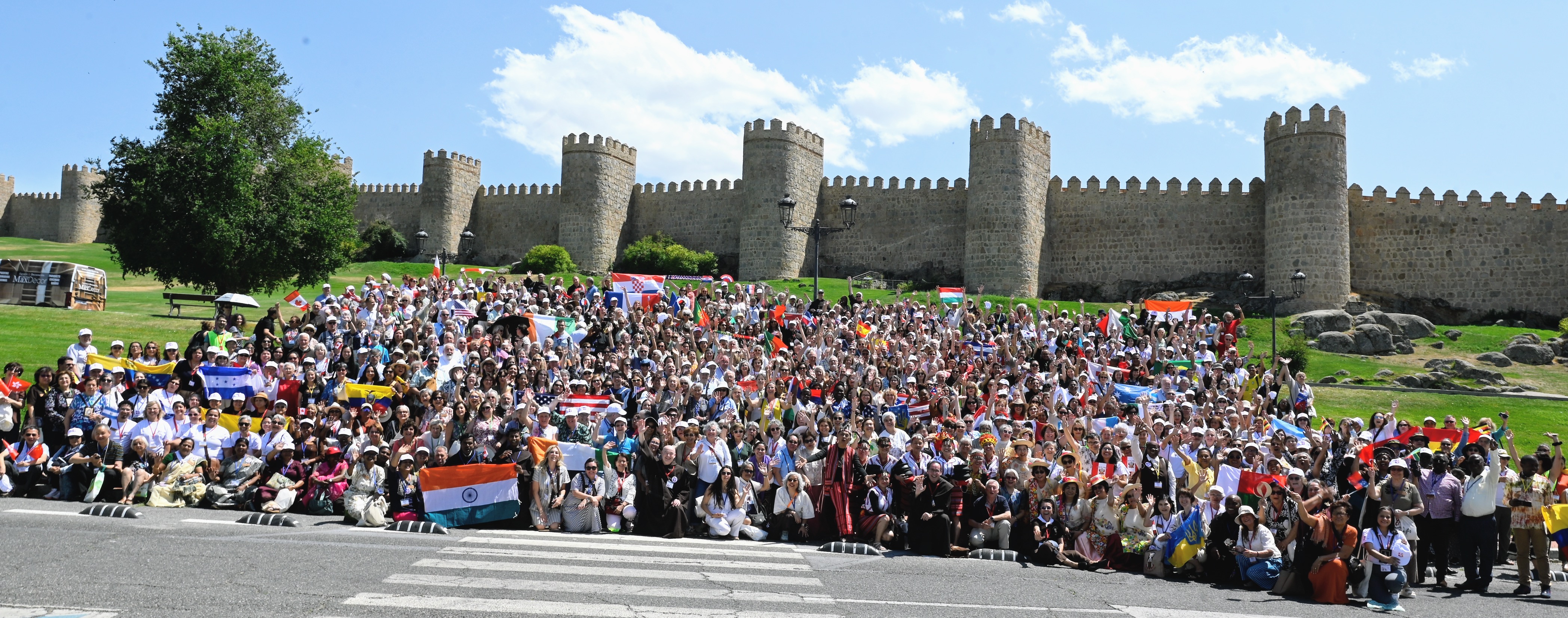
Community is the essence of the Secular Order. This may seem surprising. We don’t live in community and we meet just once a month, so how can we be a community? In fact, it is so important that, in 2014, the Vatican approved the text of a new chapter (III-B) on “Fraternal Communion” to be inserted into the Constitutions of the Secular Order. This states that:
The local community of the Secular Order of the Teresian Carmel, a visible sign of the Church and of the Order, is a place to live and promote personal and communal fellowship with God in Christ and in the Spirit and with other brothers and sisters (cf. Rom 8:29) in accordance with the Teresian charism. The person of Christ is at the centre of the community. Members meet regularly in his name (cf. Mt 18:20), drawing inspiration from the group formed by Jesus and the twelve apostles (cf. Mk 3:14-16,34-35) as well as the early Christian communities (cf. Acts 2:42,4:32-35).
Throughout the world, the core content of these regular (usually monthly) meetings is the same, giving unity and stability to the Order wherever a Secular Carmelite lives. There are three essential components to the meetings: prayer, study and social interaction, “for Teresa is aware of the importance of mutual support on the road of prayer and the importance of friendship with others in the common search for God” (III-B). We enjoy a meal or coffee together, study a Carmelite saint or text (currently St Thérèse of Lisieux with the whole Carmelite Order), have a period of silent prayer together, sometimes also participating in a parish mass and exposition of the Blessed Sacrament, and pray the Divine Office. Other forms of prayer may be included, such as the Lectio Divina method of meditating on a passage of Scripture.
The National Presidents of England and Wales, Scotland and Ireland have summarised the feedback they obtained from their Secular Order Communities to give us a window into their experiences of the effect of Covid 19 and lockdown. This article will first deal with England and Wales, followed by the summaries from Scotland and Ireland.
England and Wales
Before Covid 19 disrupted life as we knew it, communities, varying in size, age range and meeting places, had established a regular pattern, supported by national Secular Order retreats at the Carmelite Priory at Boars Hill, Oxford, and annual Regional Days. The latter were convivial occasions, when the communities within one of the seven regions in England and Wales would meet each other and pray together, and individuals would make Promises during Mass and be received into Formation. Our National Delegate, Fr Matt Blake OCD, would give a talk and provide a listening ear for advice and spiritual support.
Pandemic
Then came the pandemic of Covid 19 in 2020. Schools shut their doors in March, making on-line learning and home tuition the default options, churches closed and social distancing (of six feet or two metres) became mandatory. All non-essential travel was banned. The first lock-down was .om 26 March to 10 May 2020, the second from 24 November to 21 December 2020 and the third from 6 January to 8 March, when schools reopened in “step one” towards lifting the lockdown.
The first national lockdown in March 2020 threw our plans for national events out of the window. Retreats, Regional Days and the Carmelite Walsingham pilgrimage were cancelled, and communities could no longer meet. The further lockdowns in November 2020 and January 2021 closed the churches and gave us the infamous “cancelled Christmas”. Our triennial Presidents’ Conference, due in September 2020, had to be postponed. These cancellations gave us a deep sense of loss, of bereavement and of isolation from each other.
New ways of maintaining community
Looking at the drastic effect of three lockdowns and social distancing on our communities, one would think that they would suffer greatly, even disintegrate. How could they continue if they couldn’t meet? However, as so often happens when the Holy Spirit arranges things, the opposite occurred.
The National Council, made up of Fr Matt, the National President and the seven Regional Representatives continued to meet via Zoom, focussing on how to support the communities, offer formation and replace the cancelled events. The need for new ways of maintaining contact, of praying together, of studying and sharing business news forced many to master Zoom and other ways of keeping contact. We found that virtual meetings could cover the core material of meetings, and contribute to the discernment of vocations to the Secular Order. We were encouraged to open new windows and doors in order to meet the needs of our members.
As Zoom became part of our language, a wider range of Secular Carmelites could be included in on-line meetings, for example, those who had hitherto been unable to get to physical meetings due to such obstacles as infirmity, age, cancellation of a bus route, or change of address. New enquirers could be welcomed, however far away they lived. In spite of Covid (or because of it) twenty-six people in 2020 and twenty-five in 2021 enquired about the Secular Order through the website alone. Every person was contacted and put in touch with a community, virtual or actual, through which they could discern their vocation to Carmel.
Fr Matt replaced retreats with a series of magnificent talks on prayer and Teresa of Avila, livestreamed from Gerrard Cross Priory and later from Kensington Priory. On-line retreats were broadcast by Fr Matt and the Centre for Applied Carmelite Spirituality (CACS), as well as numerous Catholic sources from round the world. Suddenly, anyone, anywhere could find a Mass, pray a retreat, learn about prayer, study a Carmelite saint. All Carmelites were equal: friars locked down in priories, nuns locked down in monasteries and seculars locked down in their homes. There was parity between north and south, housebound and mobile, young and old.
Versatile ways of being community emerged. A virtual group for newcomers who lived too far from any community was set up and run by two experienced Seculars. Far from being dropped, formation programmes were given to some individuals over the telephone, and communities set up formation programmes via Zoom. Some groups continued to meet on their usual day with the usual timetable but did so in parallel in their own homes. When Covid restrictions allowed, those Seculars with small groups braved the rain and sleet to meet according to the ‘rule of six’ in each other’s gardens. These are to name but a few examples that showed the ‘determined determination’, so loved by Teresa of Avila, to continue to be community.
Throughout this time, in my role as national president, I tried to ‘visit’ groups, joining those who were meeting on Zoom, but the meeting that I particularly remember was when members met for a normal meeting programme at their homes in parallel. Together, they prayed in silence, ate their lunches, prayed the Divine Office, and read the book they were studying for formation. It was an extraordinarily powerful and uniting experience.
How about those who were ready to make their first and second Promises? Promises were indeed delayed, but, when churches reopened, Fr Matt offered two national masses during which six-foot-distanced Promises were made at the Carmelite church in Kensington, London and at the large parish church in Didcot, Oxfordshire.
To replace the London Regional Day, a virtual Regional Day was organised at the Kensington Priory, when many contributed and shared the day together and apart, following the Covid restrictions of distance and size of groups. It was a feat of organisation but a joyful and rewarding day.
In March 2021, I did a telephone survey of all our communities to learn how they were coping with the restrictions and give them support. More than half were meeting regularly by Zoom, three were meeting in parallel at home or in the garden and under half had no formal meeting but maintained contact by telephone, WhatsApp, or seeing each other at Mass (when the churches reopened). With each group, the sense of community and friendship and mutual support was enhanced, not diminished.
With all these ways of being community and being together, was there no end to Carmelite ingenuity and lateral thinking?
Recovery
Although Covid restrictions were lifted in July 2021, ongoing anxiety and restrictive habits, especially fear of infection from public transport, persisted. Three years on, have we recovered? Fear of Covid is still very real for the elderly and those with chronic health problems, and seeing the effects of long-term Covid on some people, this is only to be expected.
The aim of recovery is, rather than reverting to old ways, to relish the news ways we have learned of being community, of answering people’s yearning for Carmel, while reinforcing and celebrating the joy of being physically back together in our communities. We no longer want communities to be divided by those able to attend and others silent in their homes. We will no longer say to a person with a vocation to Carmel that they cannot go further on their Carmelite journey if they cannot attend a physical meeting every month. We find a way of including them. Regional Days and national retreats are even more relished occasions to be together, to make Promises and be admitted into Formation.
Presidents’ Conference
Recovery was pivoted around the triennial Presidents’ Conference 6th to 8th May 2022, delayed from September 2020. This is the decision-making body for the Secular Order; it is a time of elections and of planning for the following three years.
We prepared for this important event by circulating a roadmap containing four questions for all communities to consider before the conference:
What draws us to Carmel?
What do we see the Secular Order giving to Carmel?
What do we see the Secular Order giving to the Church?
What do we see the Secular Order giving to the world?
Their responses guided the conference programme to include five workshops covering the following topics: formation, outreach, isolated members, attracting and discerning a Carmelite vocation, small and new Secular Order groups.
This was a synodal process that would guide the Secular Order over the following three years.
Ongoing recovery is much helped by our website, that came into its own during lockdown. It offers formation material, news and events such as retreats and pilgrimages, a daily blog and more.
Looking ahead
One question from this period: What have we learned?
Flexibility and inclusion immediately come to mind. Constructive and ‘out of the box’ ways of discerning vocations and providing formation have been discovered. People are less able or willing to travel huge distances to meetings, so new groups have been formed under the watchful care of Fr Matt and experienced Seculars.
We receive a steady trickle of new enquirers through the website, many of whom are already steeped in Thérèse of Lisieux or Teresa of Avila. They are tending to be a younger age group, with commitments to their jobs and dependent families. No-one with a vocation to Carmel must be turned away. Whatever their life circumstances, we open our doors to encourage them to discern and live their Carmelite vocation to the full. This may require more flexible meetings, virtual groups, formation on-line or even over the telephone. Regional days and retreats provide the essential opportunity for all to meet other Carmelites.
Community members who are unable to attend meetings can now be included in ‘hybrid’ meetings, where they attend the physical meeting on-line, using Zoom or other technology. A small number of communities, where most are elderly and infirm, continue to rely on virtual meetings or telephone contact, and feel even more united in friendship than they were before Covid. Post Covid, I have visited nearly all the communities that are again meeting physically and am impressed by their high standard of formation, and their warm welcome to any new inceptors.
While the days of each community having their own spiritual assistant are long over, we continue to be enriched through our Carmelite friars, especially our Provincial Delegate, Fr Matt. We are learning to develop our resources and skills, to shoulder our responsibility within the Order and within the Church, always guided and protected by Our Lady of Mount Carmel.
Pilgrimages to Walsingham, Avila and the Holy Land, on-line CACS retreats and courses, and again, our useful website, provide an endless and accessible choice of formation material. Not to mention the wealth of Carmelite spirituality available on U-tube. Covid 19 has, paradoxically, opened more doors.
Reflections on the experience of Covid and Lockdown for Scottish Secular Carmelites and our Communities
In the darkness of the Pandemic, a flame burned in the hearts of the members of the Carmelite Secular Order and our six communities in Scotland. Amid the pain, disruption and distress brought by Covid, we rediscovered the simplicity of living as hermits in circumstances offering silence and solitude both external and internal. A thread linked our phone calls, emails and, later, ‘Zoom’ meetings – we were living in our ‘cells’- made visually very clear on Zoom! An Advent Retreat led by Fr Tony Parsons OCD, allowed our different communities to come together in a new way. As contemplatives, we were all in communion, praying for suffering humanity. Many of us found precious time to grow closer to spouses. Like the scattered hermits of old, we embraced new habits – online daily Mass and as small gatherings outdoors became permitted, sharing time and forging deeper bonds with Carmelite brothers and sisters and even having Formation meetings while strolling in local green spaces, sipping tea beside a pond, observing wildlife, all the while drawing from our Carmelite spirituality and applying our Rule to a new and challenging situation. As Lockdown restrictions gradually began to be lifted, we tentatively but eagerly embraced new beginnings, leaving our cares ‘forgotten among the lilies.’
Impact of Covid on OCDS Communities in Ireland
Considering all Fr Aloysius Deeney OCD’s five reasons for the OCDS having meetings -spiritual, psychological, formational, business and social/recreational – the pandemic was very difficult for the Secular Order in Ireland. The majority of members lost out on meetings as communities in general were unprepared, not tech savvy, and experienced other deficiencies.
Some communities remained essentially silent for the duration, others kept contact via email or phone, with a few members meeting on Zoom. There was only one community where most members met on Zoom.
Input from Spiritual Assistants (a Carmelite friar is assigned to each Secular Order community) was not available, and prayer as a community, such as Morning or Evening Prayer, not feasible. Communities able to use zoom for Formation purposes or Faith Sharing found it very fruitful. However, members were unable to progress through the stages of Formation due to lack of access to Rituals and they continue to experience extended initial formation durations. The National Council did meet via zoom and a National Formation Programme was successfully developed during the pandemic.
Many members contracted covid, some died including one Spiritual Assistant, and some continue to suffer from long covid. A significant number of communities have experienced a decline of members coming to meetings since the pandemic ended, with one community losing nine members. Reverting to normal meeting schedules has been warmly welcomed, although one community continues to have difficulty accessing the facilities they enjoyed before covid.
So, residual negative effects remain but some very positive ones have resulted, such as increased attendance at our National Retreats and Assembly Days and a much greater appreciation of the gift we have of our own communities and the generosity and unstinting support we receive from both the friars and the nuns. We are so grateful to God for the grace and opportunity to be able to meet together again.
Conclusion
We live our Carmelite vocation in parallel with our sisters and brothers in Carmel. We rejoice in our links with the Carmels in England and Wales, and share with the friars in their apostolate, much of which continued unabated throughout the pandemic. For example, contributions to CACS courses and the Carmelite Institute of Britain and Ireland (CIBI) courses, being spiritual guides, writing books and translation work, contributing to the Mount Carmel magazine, and leading Carmelite Contemplative Circles and Carmelite spirituality groups.
The Covid experience revealed in a deeper way ‘the Church, the family of God who is Father, Son and Holy Spirit, a mystery of communion…. this Trinitarian love and the vocation to participate in a communion of love with the Most Holy Trinity’ (Constitutions III-B).