They have washed their robes and made them white in the blood of the Lamb. (Revelation 7:14)
The first time I heard of the Carmelite Martyrs of Compiègne was in the unlikely setting of a student production of Georges Bernanos’ screenplay The Dialogues of the Carmelites at the University of Rhodesia and Nyasaland in 1965 in what is now Zimbabwe. I had a very small part as one of the Carmelites. It was only after I had entered Stanbrook in 1970 that I discovered that the two communities had shared a prison during the French Revolution.

(Photo courtesy of Ellen Sarewitz)
Bernanos’ screenplay is based on Gertrude von le Fort’s novella Die Letzte am Schafott, translated into English as Song at the Scaffold; it in turn provided the basis of Francis Poulenc’s opera Les Dialogues des Carmélites. According to William Bush, all three of these fictional accounts, though great literature, are of little historical value, containing only four facts. However, they have all, especially the opera, played a large part in spreading the fame of the Martyrs and devotion to them.
Fortunately, we have accounts of what really happened, from both a surviving member of the Carmelite community, Sister Marie de l’Incarnation (Madame Philippe) and from one of the Benedictines, Dame Ann Teresa Partington (published in 2016).
As foreign nationals the English Benedictines had been exempt from the harsh Edict of 1790 so had continued to live in their monastery and to wear their religious habits. Their chapel, unusually, remained open to local worshippers and was described by one of the nuns who later died in prison as ‘stuffed like a black pudden’ in consequence.
After the execution of Louis XVI in January 1793 and the outbreak of war between England and France, English nationals found themselves in difficulties. Father Augustine Walker, President of the English Benedictine Congregation, went to Cambrai to protect the nuns and was joined by Father James Higginson. The nuns had suffered the deaths of two abbesses within three months and had been unable to make the decision to leave the country.

Despite the promise made to the nuns on October 18, they were ordered to leave ‘in half [to] a quarter of an hour’, each allowed to take only a small bundle. Bread in the oven, wet clothes in the laundry, all had to be abandoned. They expected every moment to see the fatal guillotine.
Outside in the street, a coach and two carts awaited them, and guarded by a detachment of Hussars, they travelled for five nightmare days until they reached a former Visitation Convent in Compiègne which had been turned into a prison.

They were treated with increasing severity; on March 11 ‘stinted to coarse brown bread and water’. For three days they had nothing but six red herrings among them. A fourth member of the community, Dame Margaret Burgess, would die on April 3.
The nuns attempted to raise some money for food by offering to do needlework for the people of Compiègne, but as the windows of their room were ‘most part blocked’, ‘little could be done materially to mend their condition’. They sold a few gold crosses in order to buy bread.
On June 22, 1794 when the nuns had been in prison for about eight months, they were joined by sixteen Carmelite nuns, strictly guarded, lodged in a room opposite the Benedictines who were forbidden to communicate with them. Nevertheless, during the Carmelites’ short stay, Abbess Mary Lucy Blyde twice contrived to speak with them, ‘though with much fear’.
On July 12, the Carmelites were summoned to Paris to be guillotined. Providentially, after many requests, they had that day obtained permission to wash the secular clothes they had been wearing since their expulsion from their monastery eighteen months before and had nothing to wear except their habits.
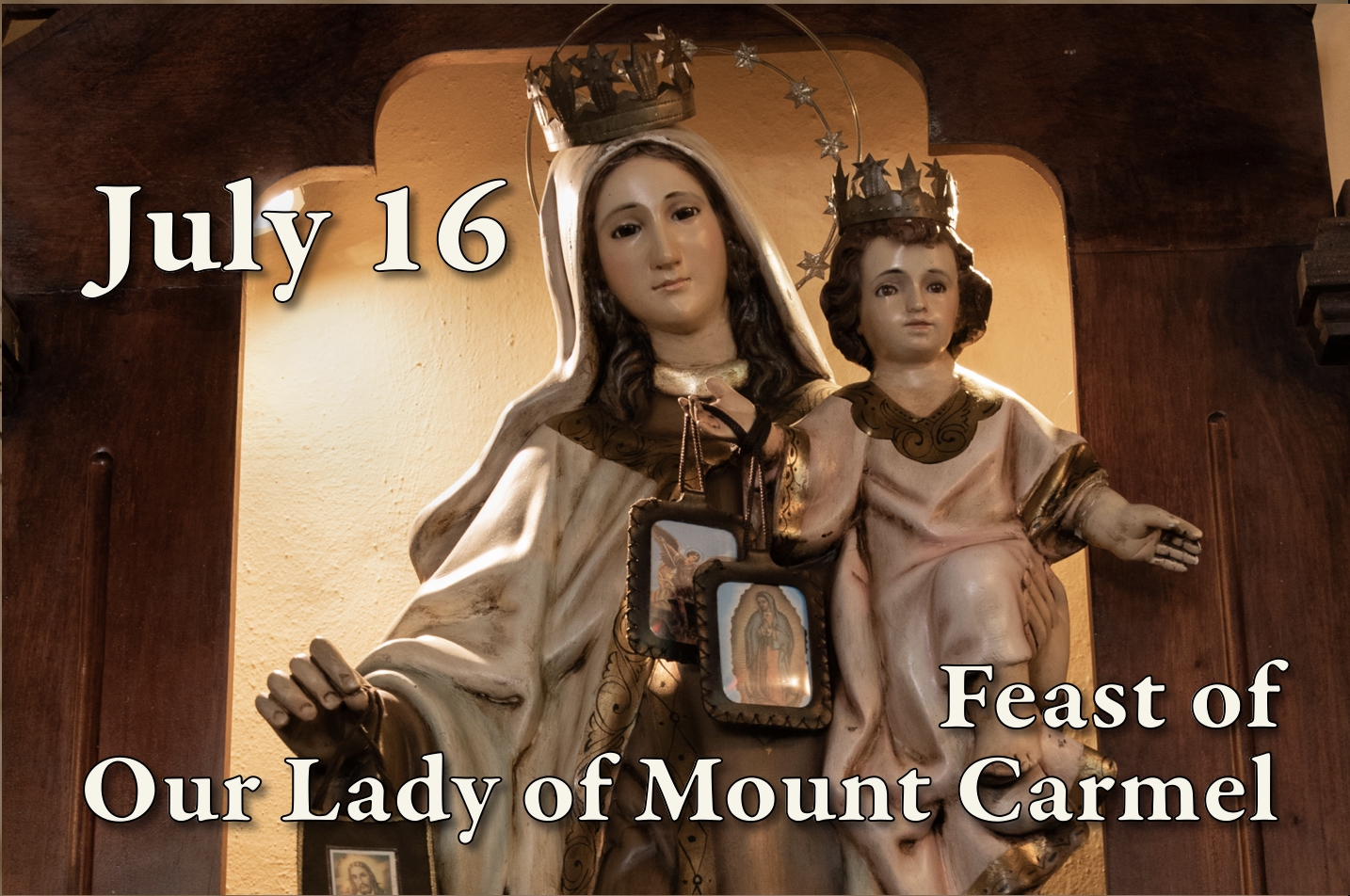
Dame Ann Teresa recounts: ‘The Nuns quitted the Compiègne Prison in the most saint-like manner. We saw them embrace each other before they set off, and they took an affectionate leave of us by the motion of their hands, and by other friendly gestures. On their way to the scaffold, and upon the scaffold itself (as we were told by an eyewitness of credit, a Monsieur Douai), they showed a firmness and a cheerful composure which nothing but a spotless conscience and joyful hope can inspire. It was reported that they sung (sic) or said (Aloud) the Litany of the Blessed Virgin until the fatal Axe interrupted the voice of the last of them. They suffered on 16th July 1794 (the feast of their Patroness, the B. Marie de Mont Carmel)’. In fact they were brought out of their final prison, the Conciergerie, on the 16thfor their trial and execution on July 17.
The narrative continues:
‘Two or three days after the Carmelites were taken to Paris, the Mayor and two members of the District of Compiègne called upon us in the prison, we were still in our religious dress which he had frequently wished us to change, but we always alledged (sic) that we had really had not money sufficient to furnish ourselves with any other clothes than the ragged Habits we then wore. The same day he returned to us again, called two of the nuns aside and told them that they must put off that uniform, as he called it, that he durst no longer permit them to wear that prohibited dress, that should the people grow riotous we should more easily be concealed in any other dress than in the religious one. The truth was he expected like the Carmelites we should soon be conducted to Paris for execution and he was afraid he might be put to trouble if we were found in the Religious garb. Being again assured that we had not money to purchase other clothes, he went himself to the room which the good Carmelites had inhabited while in Prison and brought some of the poor clothes they had left behind them there. These he gave to us, telling us to put them on as soon as possible. We were in great want of shoes. The Mayor civilly said he would get us what we wanted, but one of the jailors bluntly told the Procuratrix we should not want shoes long. On leaving the room the Mayor turned to Mr Higginson and said take care of your companions – as much as to tell him, prepare them for death, for he had nothing else in his power as the Mayor knew.
The next day the news became public that the poor Carmelites had been guillotined. The old clothes which before appeared of small value were now so much esteemed by us, that we thought ourselves unworthy to wear them, but forced by necessity, we put them on and those clothes constituted the greatest part of the mean apparel which we had on at our return to England. We still keep them, a few articles excepted which we have given to particular friends.’
In an article written by Dame Eanswythe Edwards of the Stanbrook community for the second centenary of the martyrdom in July 1994, she recounts that in a transcription from the Register of the Comité de Surveillance of Compiègne, under the date of 28 Messidor, An II, the items delivered to the community of Benedictines are listed as: ‘24 bonnets; 24 fichus; 17 déshabillés et fourreaux, qui avaient été trouvées dans la chambre des Carmélites traduites à Paris, etc.’ The tradition is that the Benedictines received these precious relics in tears and on their knees. This however seems to reflect later devotion and to contradict Dame Ann Teresa’s account.
In another part of the transcription, the number given is thirty-four bonnets and thirty-four fichus. Allowing two for each nun, thirty-four would seem to be the more likely number. Each of the remaining seventeen English nuns would then have received two caps, two neckerchiefs, a skirt and a jerkin or bed gown. Though sandals are not listed in the document, shoes are specifically mentioned in Dame Ann Teresa Partington’s narrative.
It is interesting that the two groups of nuns were almost exactly the same size.
One of the three Carmelite nuns who was absent at the time they were arrested and survived to relate their story, Sister Marie de l’Incarnation Philippe (natural daughter of the Prince de Conti) frequently visited the Benedictines in prison and gave them a list of the martyrs and their ages, written on a scrap of paper which Dame Ann Teresa later inserted into her account. As Scholastica Jacob mentions in a footnote to her edition of the manuscript, the list contains inaccuracies and discrepancies which may be due either to Dame Ann Teresa’s misunderstanding or the Carmelite’s faulty memory, either being only too understandable in the circumstances.
Here is the correct list with their correct ages as supplied by William Bush:
- Sister Teresa of St Augustine (Marie-Madeleine-Claudine) Lidoine, prioress 41
- Sister St Louis (Marie-Anne-Françoise) Brideau, sub-prioress 42
- Sister of Jesus Crucified (Marie-Anne) Piedcourt 78
- Sister Charlotte of the Resurrection (Anne-Marie-Madeleine-Françoise) Thouret 78
- Sister Euphrasie of the Immaculate Conception (Marie-Claude-Cyprienne) Brard 58
- Sister Teresa of the Heart of Mary (Marie-Anne) Hanisset 52
- Sister Julie-Louise of Jesus (Rose) Crétien de Neuville 52
- Sister Teresa of St Ignatius (Marie-Gabrielle) Trézel 51
- Sister Henriette of Jesus (Marie-Françoise-Gabrielle) de Croissy 49,
- ex-prioress and novice mistress
- Sister Marie-Henriette of the Divine Providence (Anne) Pelras 34
- Sister Constance (Marie-Geneviève) Meunier, novice 29
- Sister St Martha (Marie) Dufour, lay sister 52
- Sister Marie of the Holy Spirit (Angélique) Roussel, lay sister 51
- Sister St Francis Xavier (Élisabeth-Juliette) Vérolot, lay sister 30
- Marie-Anne-Catherine Soiron (extern sister) 52
- Thérèse Soiron (extern sister) 46
The Benedictines’ names are listed on page 16 of Dame Ann-Teresa’s manuscript and are here given in that order:
- Dame Anselma Ann, professed in 1735, died in prison on January 14, 1794
- Dame Joan or Jane Alexander, born in Tournai of Scots parentage, 1741
- Dame Frances Sheldon, born 1720
- Dame Margaret Burgess, born 1721, died in prison on April 3, 1794
- Dame Bernard Haggerston, born 1725
- Dame Mary Lucy Blyde, abbess at the time of the imprisonment, born in 1729
- Dame Teresa Joseph Walmesley, born 1739;
- she was the descendant of the martyr St John Plessington
- Dame Louisa Hagan, born 1740 in Maryland, USA
- Dame Anne Joseph(a) Knight, the niece of Dame Anselma Ann, born 1742
- Dame Ann Teresa Partington, professed in 1765
- Dame Mary Benedicta Partington, sister of the above, born 1751
- Dame Bernard(a) Barnewall, born in Dublin in 1756; who later transferred to the Cistercian community at Stapehill
- Dame Agnes Robinson, born in Lisbon in 1761
- Dame Teresa Shepherd and Dame Augustina Shepherd, born in 1762 and 1764, were the great-aunts of the community’s nineteenth-century chaplain and benefactor, Dom Laurence Shepherd
- Sister Ann Pennington, born 1734, died in prison on February 3, 1794
- Sister Marianne / Mary Ann Lefevre, born around 1735
- Sister Magdalen Kimberley, born 1745
- Sister Scholastica Caton, born 1749
- Sister Martha Fryar, born 1761
- Sister Josepha Miller, novice, born 1766
In summary: sixteen Carmelites were guillotined; three were not present at the time of the arrest and so survived. There were twenty Benedictine nuns and one novice when they were expelled from their monastery; four died in prison, making seventeen.

(Photo courtesy of Stanbrook Abbey Archives)
The survivors of the English nuns passed down their belief that the Carmelites had offered up their lives to end the Terror. Certainly, for eighteen months before their execution, under the leadership of the Prioress, they had daily made an Act of Consecration of themselves for peace in France, but the Terror hadn’t begun then. Indeed, Robespierre was guillotined on July 28, eleven days after their martyrdom. Did the Carmelites’ sacrifice actually help to save the lives of the Benedictines? Could it be said that if it weren’t for the Carmelites’ giving of themselves, symbolised by their clothes, the Benedictines would never have survived at all?
After the fall of Robespierre, the nuns took the advice of the Mayor of Compiègne and applied for passports to return to England, crossing from Dover to Calais on May 2, 1795. After long stays in temporary homes in Woolton near Liverpool and Salford Hall near Evesham, through the generosity of Catholic benefactors, they eventually settled at Stanbrook near Worcester in 1838.
The Carmelites’ red, indeed bloodiest possible, martyrdom contrasts with the ‘white’ martyrdom of the Benedictines who endured a much longer imprisonment accompanied by cold, hunger, illness, leading in four cases to death, and a very considerable amount of fear of the guillotine. Dame Agnes Robinson, who as a fluent French speaker was usually the spokeswoman for the party in prison, though in her thirties at the time of the return to England, ‘had the appearance of an aged person and a constant slight trembling of the head, from the effects of the terror’. Sister Jane Miller, the novice, survived to be professed in March 1796 but never recovered from the hardships of the prison and died four months later on July 15.
Several of the nuns were blood relations of actual martyrs: St Thomas More, Thomas Gascoigne, John Plessington; and the Benedictine Order produced at least nine more, three of whom have been canonised: John Roberts, Alban Roe and Ambrose Barlow.
All of the nuns were sustained by the spiritual tradition in which they had been nurtured. The Carmelite Order had of course produced the well-known spiritual giants St John of the Cross and St Teresa of Avila, both writers of spiritual masterpieces. The Benedictines were nourished by the teachings of their early mentor, Father Augustine Baker, the essence of whose teaching is quite as demanding and all-embracing as theirs. He summarised: ‘the ende of the Rule (of St Benedict) is to bring the Soule…to a Perfect Union with God’ by means of mortification and prayer. His earliest and most steadfast disciple, Dame Catherine Gascoigne, abbess of our community for forty years, described prayer as ‘tending to unity’, imageless, ‘seeking only that one thing necessary’, ‘the way of humility, of abnegation, of sincere obedience, of perfect submission and subjection to God and to every creature for his love’. It is attested that Dame Anselma Anne, the first of the community to die in prison, was remembered as ‘a very holy soul, given much to the interior contemplative life’.
The further history of the Carmelite relics is preserved in the Stanbrook Annals: ‘As soon as our community could procure fitting clothing to replace the poor worn-out garments in which they had been clad during the last nine or ten months of their imprisonment, they did not forget that this cast-off apparel constituted valuable relics of their martyred co-prisoners…and they treated these articles as such… many friends were made partakers of this priceless deposit by an ample distribution of these garments or portions thereof.’

viewed from the top of the above reliquary.( Photo courtesy of Ellen Sarewitz.)
On the occasion of the first centenary of the Martyrs, Stanbrook’s only French abbess, Gertrude d’Aurillac Dubois, wrote to the Compiègne Carmel making known that we had been their fellow prisoners and that we still possessed some of their clothes. A warm correspondence ensued which led, with the unanimous consent of Chapter, to our giving half of our relics to them. Our Annals describe the garments as being ‘fashioned in the style of the poorest French peasants’ costume; they were of the coarsest description, thin and patched, of various colours and utterly unlike any religious garb’. Apart from a cap of white linen…and a few pieces of variously coloured cotton material, probably the remnants of jerkins or bed-gowns, there remained at Stanbrook only one sandal and one jerkin of coarse cotton, much mended. The sandal or ‘spargate’, sometimes also called an alpargate, which was described as being of white hemp canvas with a sole of twisted cord, was divided lengthwise. A paper pasted to the sole was inscribed in the handwriting of one of the Cambrai nuns:
This sandal formerly belonged to one of the Carmelite Nuns of Compiègne who was guillotined at Paris under Robespierre. They were put to death July 16th 1794, the feast of their Patroness, Our Blessed Lady of Mount Carmel.
The Annals note that the error of date by one day indicates that the testimony is really oral, and not taken from a gazette of the day. Being in prison, the Benedictines had learnt the facts by hearsay.
The jerkin was also cut in half.
On September 25, news reached Stanbrook of the first miracle attributed to the Martyrs by virtue of the relics, the cure of the five-year-old nephew of one of the Compiègne nuns, and in May 1896 came the extraordinary cure of a four-year-old English boy, Crathorne Anne, a great-great-nephew of Dame Anselma Anne who died in the Compiègne prison.
Abbess Gertrude and other Stanbrook nuns were unable to go to Paris for the Tribunal for the Cause of the Carmelites because of enclosure, but instead invited the Tribunal to Stanbrook. The Tribunal took place on August 28 and 29, 1897 in French. Abbess Gertrude was dying of cancer; she deputed Dame Benedict Anstey with an interpreter to present the evidence.
The Tribunal returned to Stanbrook between August 24 and 28, 1903 for the Apostolic Process, welcomed this time by Abbess Cecilia Heywood, who also provided part of the sandal and a piece of the remaining jerkin for the Beatification of the Martyrs in St Peter’s on May 27,1906.
After the Beatification, an Apostolic Delegation was instituted to come to Stanbrook for the special purpose of solemnly recognising and sealing the relics on July 14, 1906. The ceremony took place in the Chapter House which had formerly been the community’s chapel where nuns who remembered the Cambrai survivors had chanted God’s praises. The relics were displayed on a large table draped in red velvet and included a cap bearing the laundry mark of Sister Scholastica Caton, two neckerchiefs and a piece of red and white cotton, discovered the previous month at Chichester Carmel.
The relics were placed in a shrine carved in oak and gilded, a reproduction in miniature of St Ursula’s shrine at Cologne. The six side-panels represent scenes from the Martyrs’ lives including their departure from the prison, with the Benedictines waving from a window; and the distribution of their secular clothes to the Benedictines.
At Benediction on the final day of the Triduum, Crathorne Anne was present on the Sanctuary as Trainbearer for Bishop Lesley of Birmingham.
The Bishop and other prelates each received a copy of Stanbrook’s new edition of St Teresa’s Interior Castle, translated by Dame Beatrice Brown and printed by Stanbrook Abbey Press.
In 1994, Abbess Joanna Jamieson and Dame Lucy King, accompanied by the reliquary, were the guests of the Notting Hill Carmelites to celebrate the second centenary of the Martyrs, the high point being a Mass celebrated by Cardinal Basil Hume, OSB.
It had been hoped that the Carmelite Martyrs would be canonised that year, but that was not to be. Now, thirty years later, it appears that Pope Francis has fast-tracked their canonisation by a process called ‘equipollence’, which means that no further miracles attributed to them are necessary.
It remains only to say that we at Stanbrook, now in Wass, North Yorkshire, have continued our warm relationship with several Carmelite communities, notably the community at Thicket near York. They moved from their old monastery to a new purpose-built one in their own grounds on the very day we moved from Worcester to Wass, May 21, 2009. We have had many reciprocal visits including the feast of Carmelite Martyrs in 2010 when the entire Thicket community spent the day with us.

(Photo courtesy of Stanbrook Abbey Archives)