As Carmelites we are blessed to have so many saints in heaven that it is hard to know them all, and before I went to Belgium I have to admit I knew nothing about Blessed Anne of St Bartholomew.

As the ship sailed off from Dover, my expectations for the week consisted of rest, sun, and a good drink along the way. Having just finished four straight months of studying, the rest was well needed, but I was unexpectedly surprised by a visitor who accompanied us on our journey.
After the ferry, the remaining passengers and I were re-bundled into the FlixBus bound for Bruges, where I stayed in the historic Carmelite community of St Joseph’s. As an Englishman, this was my first experience of an historic Catholicism. I am so used to walking into a beautiful chapel with the expectation that it must be Anglican that I found myself moved when realising that all of this was Catholic and therefore mine. It was like seeing your small town football club launched into the Premier League; I felt a great sense of pride.
The monastery of St Joseph’s was amazing. The size was unimaginable, yet the community retained a homeliness about it, compounded by the friendliness of the friars who lived there. On the Tuesday, Fr Martin, the Prior, gave us a tour of the monastery, and one person kept on popping up from the stairwell to the loft. It was, of course, Blessed Anne of St Bartholomew.

It was clear to me that she was beloved by the Carmelites in Belgium, and I was surprised at my little knowledge of her life and work. Yet this seems in keeping with her life. She was a simple shepherdess before becoming a lay sister due to her lack of education. Habituated to always taking the lower part, she imitated the words of St John the Baptist when he said, ‘He must increase, but I must decrease.’
It was probably this attribute that drew St Teresa to her, for despite being of different temperaments they both understood the benefit that silence and humility provide in having an intimate relationship with the Lord. Unfortunately, they were both unable to fulfil this desire for the quiet life.
She writes in her autobiography: ‘Once I said to the Infant Jesus: ‘My Lord, since you are keeping me company, do not let us go any more where there are other persons, but let us go alone to some mountains, for with your company nothing will be wanting to me.’ But He smiled and, without speaking, made me understand that was not what He wanted of me.’1

Unfortunately for her, there were just as many paintings of her in the community of Ghent as there were in Bruges. The friars took ownership of an old zoo in 1651 and used that as the base for the monastery in Ghent. Luckily, by the time the friars arrived, the zoo was long gone, and the community now boasted a lush garden and baroque church, though signs of their heritage still remained.
The antiquity radiated even from the building, as the bones of previous friars were buried in the very foundations of the monastery. The friars in Ghent had not forgotten the historic role that Blessed Anne played in establishing the Carmelites in Belgium, and at her behest her face started to become a familiar sight on our journey through the country.

Yet Blessed Anne’s legacy spans further than just her ecclesial triumphs, as she is fondly remembered by both Church and State. Nowhere is this more evident than in Antwerp, which was the last stop of our journey.
Blessed Anne was hailed by the people of Belgium as the ‘protector of Antwerp’ for her role in saving the city from being ransacked. In 1622, Maurice of Orange sailed out to capture Antwerp, yet he failed to count on the power of prayer. Anne was awoken that night as she slept in the monastery she had founded in the city. She began to pray with her hands raised to heaven as she interceded for the people. Eventually her arms grew tired, but as she lowered them she heard the Lord say to her, ‘It is not yet time to stop; keep them raised towards heaven.’2 And she remained like this until near daybreak. As the townspeople looked out that morning, they saw the wreckage of the ships on the shore of the port, thanks to the prayers of Blessed Anne.
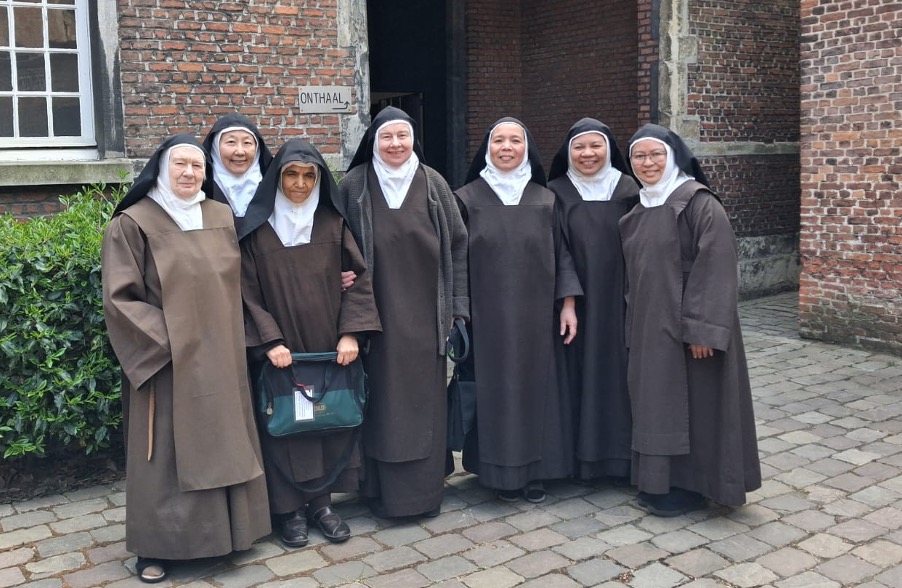
This scene is cast in metal on the side of her reliquary, which rests in the chapel of the convent she founded in Antwerp. By now I was good friends with Blessed Anne of St Bartholomew, and so when I and the other friars I travelled with were invited into the public chapel of her convent it felt like a homecoming.

The sisters received us most graciously, and praying before her relics was a true privilege — but the highlight of the trip came when they invited us into the cell where Blessed Anne died. The size of the cell was the first thing that struck me: it was only about seven by seven feet, and with all of us crowded in there it soon became cramped. Scattered throughout were various objects from Anne’s life — her shoes, pens, and books — all as she had left them 400 years before. To be so close to one of the principal members of the Reform brought it to reality, and St Teresa’s influence could be felt everywhere. Her influence extended even to Blessed Anne’s poor handwriting, which is perhaps unsurprising given that Teresa herself had taught her to write; like mother, like daughter.
Despite the cramped space, the room held a prayerful atmosphere as the sisters passed round Blessed Anne’s mantle for each of us to wear, and when my turn came, I asked for her intercession on my own Carmelite journey.
During my time in Belgium, I had received everything I expected and more. There was plenty of sun and a large variety of Belgian chocolate and beverage treats than I ever imagined, and yet now, as I reflect from the comfort of my cell in rainy London, I cannot help but feel that I brought Blessed Anne back with me.
- Anne of St Bartholomew, Autobiography of Blessed Anne of St Bartholomew, trans. by a Religious of the Carmel of St Louis (Missouri: n.p., 1917), p. 7, Book I, Ch. III. ↩︎
- Anne of St Bartholomew, Autobiography of Blessed Anne of St Bartholomew, trans. by a Religious of the Carmel of St Louis (Missouri: n.p., 1917), p. 105, Book IV, Ch. VII. ↩︎